
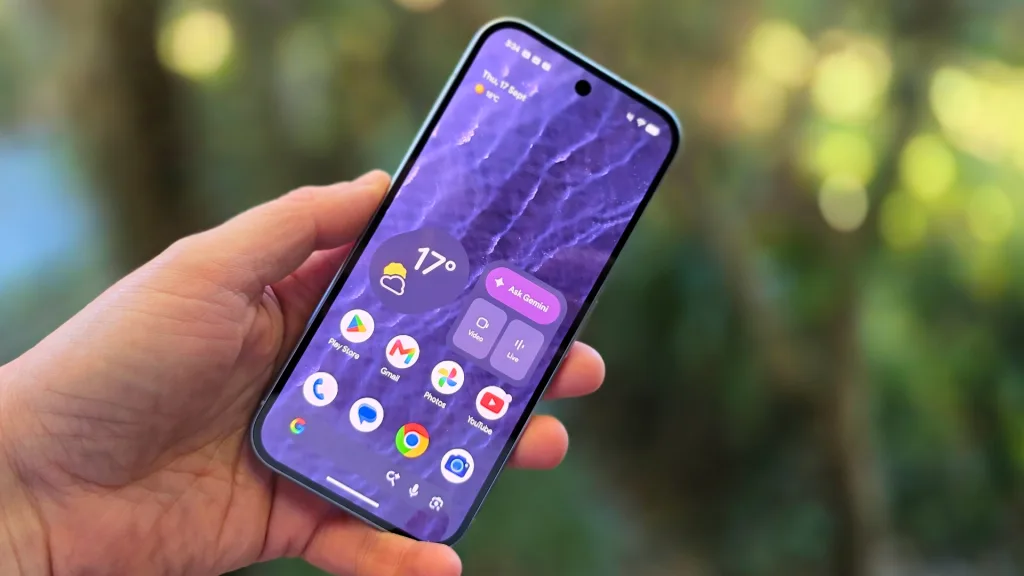
The Pixel 11 isn’t Google’s fanciest flagship phone this year… but it’s arguably the best value Google flagship to buy if you’re solidly in the Pixel camp already.
| Pros | Cons |
|---|---|
| Same Tensor G6 as the Pixel 11 Pro phones | Tensor G6’s AI-first approach won’t appeal to everyone |
| More fun colours than its Pro siblings | More expensive than last year’s Pixel phones |
| Nicely capable cameras for an “entry level” flagship | If you do want advanced Google AI features, it’s going to cost you from day one |
Score: 3.5/5
In this review
Google Pixel 11 Specifications
Google Pixel 11 Design
Google Pixel 11 Camera
Google Pixel 11 Performance
Google Pixel 11 Battery
Google Pixel 11 Verdict
Ethical disclaimer:
The Google Pixel 11 used in this review was sent to me by Google Australia, and they have indicated that they’re not going to ask for it back.
That’s their call, but it buys them no particular favour or position here at ART. I believe in fair reviewing, upfront and 100% transparent disclosure and content that actually helps readers make better technology purchasing decisions, not just what might curry favour with large international technology firms. Not… everyone in the tech reviewing space thinks that way, more’s the pity.
For more on ART’s Ethics position, see here.
Design

The issue I’ve long had with Google’s lower tier Pixel phones – and I’m talking here of devices like the Pixel 8, 9, 10… heck, if I wanted to dig through my reviewing archives, while some of the reviews are no longer online, I’ve written reviews and still have the copy of reviews of every single Pixel model and the Nexus phones before them, but I once again digress… where was I?
Oh yes, the base model Pixel phone of a given year.
They’ve often been decent devices that ultimately failed to stand out next to their “Pro”, or later on “Fold” equivalents when it came time to my purchasing recommendations.
At a design level, there’s relatively few surprises to be had out of the Google Pixel 11. If you look back through the past couple of generations, you’ve long been presented with a 6.3 inch 120Hz capable OLED display with minimal bezels. From the front, most wouldn’t pick the Pixel 11 out of a lineup in any way.
Also read:
Google Pixel 11 Pro Fold Review
Even from the back, there’s only been a slight degree of change. The camera bar at the rear has had a slight redesign so that it sticks out slightly less than on prior models, and the separation between the sensors and flash is less defined with an all-black bar. It’s a subtle change, and again, one that you’re not likely to notice without placing them side by side.
What you do get, and it’s a feature I approve of heartily, are a range of fun colours. Opt for the Pro series Pixel 11 phones and everything is very drab and serious and businesslike and that’s all. If drab and serious is all you want in a phone, then Google stalwart colour Obsidian (AKA “Black”) is a Pixel 11 choice, but alongside that you get the option of Pistachio (bright green) or Hibiscus (a very hot pink) or the Frost (Light Blue/Grey) option Google sent my way.
Other than a slight dip in weight down to 197g from the Pixel 10’s 204g, pretty much everything else is the same when it comes to the Pixel 11. The controls are the same simple set, charging and data is handled from the USB-C port at the base, and the entire phone is IP68 rated for dust and water ingress.
The design certainly doesn’t make a compelling argument to upgrade from a Pixel 10, because they’re externally essentially the same phone with just a few small tweaks.
One feature found on the “Pro” Pixel 11 lineup you don’t get is the “HiLight” notification LED. Having tested that out on the Pixel 11 Pro XL and Pixel 11 Pro Fold and found it totally underwhelming, I don’t think you’ll miss it much. I certainly wouldn’t.
Camera

On the camera side, the Pixel 11 also talks a familiar tune with, on paper, the same sensor array as its predecessor. That gives you a primary wide 48MP sensor, ultra-wide 13MP sensor and 10.8MP 5x telephoto sensor at the rear, plus a front-facing 10.5MP sensor.
I say on paper, because Google’s contention is that while the ultra-wide and telephoto sensors are indeed unchanged, the actual sensor on the primary wide camera is larger, giving it greater scope for catching light in dimmer situations… which should in theory lead to better photographs.
What captures (photo pun not intended) my interest here is that the combination of a better wide sensor, which most people will use for everyday photos with one of the only “entry level” flagships to incorporate proper telephoto leads to a camera that can shoot quite well, and in some cases better than its much more expensive counterparts.
I’ll give you a practical example here; when I tested out the Pixel 11 Pro Fold, I used a 30x telephoto shooting test focused (hey, another camera pun, I’m on a roll here…) on the clock tower at Sydney’s Central station. So I ran the same test with the Pixel 11, just to see how the “cheaper” Pixel managed.
Here’s the shot with the ultra-wide lens, and it’s worth noting that the camera on the Pixel 11 is actually technically better than the one on the Fold at 13MP. A fine shot if you really like the sky…
‘
Likewise, the standard wide shot does nicely, even though the sun was starting to go down as I was taking my photo.

Let’s pump it all the way up to 30x, shall we?

The differences between what I can shoot with the Pixel 11 Pro Fold and the Pixel 11 are marginal – I like the 30x shot that the Pixel 11 Pro Fold shot a little better, but I shot it on a different day and the light levels were just plain nicer on that day… but what isn’t marginal here is the difference in price, because the Pixel 11 Pro Fold’s asking price starts at double that of the Pixel 11.
This isn’t to say that all Pro phones are now worthless rubbish; there are still limits to what the Pixel 11 can shoot, even with Google’s AI-led post-processing in play. But for everyday users, it’s a nicely capable camera, and the smaller size of the phone could be highly appealing to those who prefer an easier to handle camera too.
Google Pixel 11 Sample Photos

Obligatory cat photo. Black cats aren’t always easy to photograph while retaining fur detail, but here the Pixel 11 does a nice job.
Also, yes, she is judging YOU.

This was taken in a darkened room to test out the lower light capabilities of the Pixel 11, sans flash. It did well. Also, I clearly need to dust my Godzillas more frequently.

Obligatory selfie. AI still can’t turn me into a Hollywood Hunk… but I’m not 100% sure I want it to.

This food photography is making me hungry…

A second cat photo isn’t strictly speaking obligatory… but it’s my review, I’ll do as I please here.
He isn’t judging you, he’s not capable of thought quite that deep.
Performance

Like its Pro counterparts, the Google Pixel 11 is built around Google’s fancy new Tensor G6 processor.
Also like the lower storage tier Pixel 11 Pro lineup, the Pixel 11 comes with 12GB of RAM, but I’m less inclined to get cranky with Google about that, because that’s the same as it was last year; if you wanted higher level RAM inclusions on Pixel phones, you’ve had to buy the Pro models for quite some time.
Having tested out the Pixel 11 Pro XL and the Pixel 11 Pro Fold already, I had a good idea of what to expect out of the Pixel 11 when it came time to benchmark it. I’ve stuck with Geekbench 6 (despite having to sideload it) here as I can use it for a better longitudinal comparison with other phones, though Geekbench 7 is now available.
I’ve included the Galaxy S25 Ultra and iPhone 17 in the comparison because I’ve not as yet had the opportunity to test out the Galaxy S26 family or the iPhone 18 models either – and also, honestly, because with a little shopping around it’s not that hard to find models of those phones at around the same asking price as the Pixel 11 anyway.
The Tensor G6 is, ultimately, a bit of an underperformer in straight line CPU terms, even though it does perform better if you look up the Pixel ancestral line. You’d expect that, really.
It’s much the same story at a GPU level, where the Tensor G6 isn’t exactly cutting edge.
Google’s contention here is that benchmarks aren’t everything – this is possibly why they tend to block them from running prior to sale, ahem – but also that Tensor processors are more finely tuned for specific AI-led tasks, using Google’s Gemini platform.
I’m not 100% convinced there; I feel like it’s both desirable and feasible to get premium performance out of what are still premium-priced devices, but it’s also quite stark for the Pixel 11 because unlike the Pro phones, you don’t get a specific Google Pro AI subscription thrown into the deal.
Google cut that freebie deal back to just 6 months rather than a year for the Pro phones this time around, but the regular models have always only just had the standard 30 day trial as an option.
That’s a deal you don’t need to buy a Pixel phone for, and if you’ve already had a trial, you can’t get another, which does limit how heavily you’re going to leverage the AI chops of the Tensor G6 in the Pixel 11.
At that point, what you’re facing is paying Google’s AI pricing at either $7.99/month for its AI Plus tier, $32.99/month for its Google AI Pro tier or a hefty $149.99/month for its Google AI Ultra tier.
Something tells me… call it a hunch… that not too many Pixel 11 buyers will be opting for that Ultra tier, as within a year you would have spent more on AI than on the phone itself!
Battery

The Google Pixel 11 runs from a 4985mAh internal sealed battery, which means in a year’s time, it’s gained just 15mAh over the Google Pixel 10. That’s the kind of battery life change that can be rendered entirely meaningless by just one power-hungry app running for a very short period of time, but then again, the Pixel 10 still sits as one of the better overall performers in the flagship space for tested battery life. My front-runner there for some time now was the Pixel 9, which runs on just a 4700mAh battery.
Or in other words, battery capacity numbers rarely tell the whole story. In terms of Google’s claims about the Pixel 11’s battery capabilities, it’s meant to be capable of “30+ hours” of battery life, which is the same claim Google made for the Pixel 10 last year.
Battery life is a complex matter, because everyone’s app usage differs widely – you can read more about how I test phone batteries here, or watch the video below for more on that.
To put the Google Pixel 11 through its comparative battery life paces, and to see if it could topple the Pixel 9, I ran it through my standard YouTube-based battery test. Could it claim the throne for battery performance?
So close… but not quite, Pixel 11. That extra 15mAh – and being more serious for a second, the presumed efficiencies of video processing within the Tensor G6’s cores – does at least tilt it more heavily towards the king than the Pixel 10 does, which is pleasing.
The practical day to day reality here is that all but the most demanding users will easily see a day’s usage out of the Google Pixel 11. 30 hours may be feasible, but that’s only likely for users who only intermittently use the device, because I can attest that with heavier use, it’s still feasible to run it flat within just one working day.
While you’ll have to provide your own charger either way, the Google Pixel 11 is fully Qi2 compliant, which means that it not only wirelessly charges at up to 25W, but also supports magnetic attachment – “Pixelsnap” in Google-speak if you want the official accessories.
It befuddles me that more premium Android phone makers haven’t incorporated Qi2 into their designs, because it does feel like such an easy win for consumers in the flagship space.
Google Pixel 11: Alex’s Verdict

As I noted in my intro, I’ve long had the feeling that Google’s entry level flagship Pixels were always hard to recommend, because they were the cut-down Pro phones with most of the pricing still intact.
That’s still somewhat true for the Google Pixel 11, but I feel like the value calculus has shifted in its favour somewhat.
Google’s price rises on its Pro phones and the fact that some models of the Pro series will run at the exact same speed as the Pixel 11 means that in performance terms it’s a Pixel-comparative bargain. Add into that some very capable cameras and solid, but not quite best-of-breed battery life, and the Pixel 11 becomes even more compelling.
That’s if you’re only after Pixels, however.
In the wider phone space, I’d consider my options and consider the deals available to you at the time of buying, because it is still hard to look past the dual realities of Tensor processors still lagging behind their competitors, and the way that Google’s positioning the entire line as a gateway to an ongoing Google AI subscription.
There will of course be some buyers happy to pay that ongoing price, and for them, the Pixel 11 is an excellent buy, because it’s got all the grunt without the pocket price hit of its Pro counterparts.
If you’re only an intermittent AI model user, or have no plans towards heavier AI use, then I’d definitely look and compare around what’s available to you.
Was this review useful to you?
Support independent media by buying me a coffee!
Find out more about how you can support Alex Reviews Tech here.
About the Author


